This article is based on a brochure called “Appeals in Medicaid Managed Care Plans: What to do if you disagree with your Medicaid plan’s decision”. You can read it online or download this printable version. Scroll to the end to view versions in other languages.
How to use this brochure
Read this brochure from the beginning to learn about Medicaid managed care plan appeals, or use the Table of Contents to review specific details about the process. You can use the Table of Contents to skip straight to your question.
This brochure may contain some words that are new to you. If you see a word or abbreviation you don ‘t know, you can find the meaning in the Glossary at the end of this brochure.
Table of Contents
Introduction
What is an appeal?
What kinds of decisions can I appeal?
How will I know if my plan takes an action?
When can I appeal?
What is aid continuing?
How do I request a plan appeal?
If you request a plan appeal in writing
If you request a plan appeal by telephone
Who can request a plan appeal?
What should I include with my plan appeal?
When will I get a decision?
What happens if my plan appeal is denied?
What is an External Appeal?
What is a Fair Hearing?
Aid continuing in second-level appeals
What if I am in a MAP or FIDA-IDD plan?
Appeals Contacts
Glossary
Appeal Process Diagram
ICAN Can Help You
Introduction
If you have Medicaid health insurance in New York, most likely you are a member of a managed care plan. This means that the State pays a health insurance company to manage your Medicaid benefits.
When you join a Medicaid managed care plan, you have certain rights. One of those rights is the right to appeal a health related decision that you disagree with. This means you can ask for someone to review the decision and decide whether it was right or not.
This brochure explains the appeals process for Medicaid managed care in New York. There are many different kinds of Medicaid managed care plans. The appeals process works a little differently for MLTC, MAP, PACE and FIDA-IDD plans. This brochure will highlight the differences.
What is an appeal?
Most of the time, your plan will cover the health care you need. But sometimes, your plan may decide not to cover the health care that you or your provider think you need. An appeal is a way to tell your plan that you disagree with them, and to ask them to change their decision. When you appeal, your plan must give you a chance to show why you think the decision was wrong.
There are different levels of appeal. The first level of appeal is an appeal with your plan, also called a plan appeal.
If you disagree with the decision your plan makes on your plan appeal then you have the right to a second-level appeal. A second-level appeal is reviewed by someone who doesn’t work for your plan. The reviewer will decide if the plan’s decision was correct or not. If the reviewer agrees with you, then your plan must follow the reviewer’s decision and give you the service.
What kinds of decisions can I appeal?
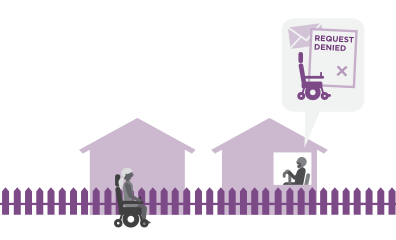
Not all plan decisions can be appealed. You can only appeal an action by your plan. Actions are usually about a healthcare service you want your plan to cover.
You have the right to appeal if your plan takes one of these actions:
- denies, decreases, or limits services requested by you or your provider;
- denies a request for a referral to a specialist;
- decides that a requested service is not a covered benefit;
- restricts, reduces, suspends or stops services that were already authorized;
- denies, in whole or in part, payment for services;
- doesn’t provide timely services; or
- doesn’t make a complaint, a complaint appeal, or an appeal determination within the required timeframe.
If you are unhappy with your plan about something that isn’t listed above, you can’t file an appeal, but you can file a complaint.
How will I know if my plan takes an action?

If your plan takes one of the actions on that list, they must mail you a written notice. This notice is called an Initial Adverse Determination (IAD).
This notice must have certain information:
- The specific action they are taking;
- The specific reasons for the action;
- Your appeal rights;
- Instructions on how to file an appeal;
- Instructions on how to have a fast track appeal;
- Your right to get a free copy of all documents related to the action;
- Your right to get a free copy of the plan’s rules about the service they denied;
- Any information the plan needs from you to decide your appeal.
Defective Notice
- If your plan’s IAD is missing any of the required information, it may be defective. This could make a difference in your appeal.
- If the action is to reduce, suspend, or stop a service you are already getting, your plan must send you this notice at least 10 days before the date that this service is set to be reduced, suspended, or stopped (the “effective date”). If they do not, that may also mean the notice is defective.
Whenever your plan sends you an IAD notice, it means you have the right to appeal. But sometimes, your plan may take an action without sending you a notice. If this happens, you still have the right to appeal that action.
When can I appeal?
You must request your plan appeal before the deadline, or it will not be acted upon. You have 60 days from the date of the IAD notice to file your plan appeal. Your deadline to appeal should be stated on the first page of the notice.
If the action is to reduce, suspend, or stop a service you are already getting, this deadline is sooner.

What is aid continuing?
If the action your plan intends to take is to reduce, suspend, or stop services you are already receiving, then you can request aid continuing. Aid continuing means that the plan must keep your services at the current level while you wait for a decision on your plan appeal. However, you can only get aid continuing if you request your appeal very quickly.
To get aid continuing, you must request your plan appeal before the effective date of the action, or within 10 days of the date of the IAD notice, whichever is later. The IAD notice will state your deadline for aid continuing on the first page.
If you lose your plan appeal, you may be asked to pay for the cost of any continued services that you received as aid continuing.

How do I request a plan appeal?

You can request a plan appeal in writing, by telephone, or by fax. Some plans may also accept plan appeals by email or online.
If you have received an IAD notice, the notice itself will include instructions on how to request a plan appeal. It should include a pre-populated Appeal Request form that you can send to the plan to request the appeal.
Using this form is the best way to request your appeal, because it already has all the information the plan needs to correctly process it. If you send this form by fax, email, or certified mail, you will also have proof that you appealed before the deadline.
It is best to request your plan appeal in writing so you will have proof of filing. However, it may be better to request your plan appeal by telephone if you are very close to the deadline.
When you request the plan appeal, make sure the IAD notice accurately states the decision you want to appeal. If it does not, you may need to get the notice corrected before you can start a plan appeal.
If you request a plan appeal in writing

- The last page of your IAD notice is an Appeal Request Form that you can use to request the plan appeal.
- Fill out the Appeal Request Form, sign and date it at the bottom, and send it to the plan by fax, mail, or email if the plan accepts plans appeals by email. The contact information should be on the form. If you fax the form, keep the fax confirmation so you have proof of delivery.
- Mailing should be your last option, as your documents can get lost or delayed.
- Do not send the Appeal Request Form to ICAN unless an ICAN advocate requests it. You must send your plan appeal to your Medicaid plan in order for it to be processed.
- There is space on the form to briefly explain why you think the plan’s decision is wrong. However, you do not need to address everything in the decision that you disagree with.
- For example, you could write, “The plan’s decision to deny my request for a wheelchair is wrong because I have medical conditions that make it impossible for me to walk.”
- You can still request a plan appeal in writing if you don’t have the Appeal Request Form. Be sure to include the decision you are appealing, a brief statement of why you think the plan’s decision was wrong, your name, and member identification (ID) number.
- It’s a good idea to call your plan a few days later to confirm that they received your plan appeal and are processing it.
If you request a plan appeal by telephone

Call your plan’s member services telephone number, and write down the date, time, and the name of the person you spoke to.
Be specific about the decision that you are appealing. There is usually a reference number for the decision on the IAD notice.
Who can request a plan appeal?
You or anyone you choose can request a plan appeal on your behalf. You may want to submit an authorization form to your plan, letting this person act on your behalf for all future appeals. The plan will keep this authorization form on file. There is no special form that must be used. You may develop your own. You can also name a representative on the appeal form itself. If you have given someone Power of Attorney or Healthcare Proxy, that person should be able to file the appeal on your behalf.
What should I include with my plan appeal?

You do not need to provide any specific documents for your plan appeal to be processed. However, it can be stronger if you include documents that show why the plan’s decision was wrong.
These are examples of supporting documents:
- Doctor’s Letter – Ask your doctor for a letter explaining why your request is medically necessary.
- Medical Records – These can include recent progress notes from your doctor’s office, or discharge paperwork from a recent hospital or nursing home stay.
- Case File – Your plan must send you a copy of your case file after it receives your plan appeal. Your case file includes documents that it used to make its decision like assessments, home care tasking tools, case notes, and other records. You have a right to get a free copy of your case file before you request a plan appeal.
- Task Log – If you are seeking more hours of home care services, keep a log of the daily activities that you need assistance with during the hours you don’t have an aide. It is best to keep this log for 3–5 days in a row.

When will I get a decision?
There are different deadlines for your plan to decide your plan appeal:

For a standard plan appeal
The plan must issue a decision as fast as your condition requires, but no more than 30 calendar days from when you asked for the plan appeal.
For an expedited (fast track) plan appeal
The plan must issue a decision no later than 72 hours (about three days) from when you asked for the plan appeal.
Note: For both kinds of plan appeal requests, you can ask for an extension of up to 14 days if you need more time to submit information to the plan. The plan can also extend its deadline even if you don’t ask for it. The plan must give you written notice describing why it is extending its deadline.
Your plan must automatically expedite (fast track) your appeal if:
- You are asking for more of a service you are getting right now.
- You are asking for home care services after you leave the hospital.
Your plan should also expedite your request if your doctor provides a letter stating that your health could be harmed by waiting 30 days for a decision.
There may be other circumstances where your plan should expedite your appeal, for example if it relates to certain substance use or mental health services.
If your plan doesn’t make a decision on your appeal by the required deadline, it is considered an automatic denial. This means that you can request a second-level appeal.
What happens if my plan appeal is denied?

If your plan denied your appeal (meaning they decided not to change their decision about your services), it must send you a Final Adverse Determination (FAD) notice by mail. This notice must tell you the plan’s decision, the reason for their decision, and your appeal rights if you disagree with the decision.
If you disagree with your plan appeal decision, you have the right to request a second-level appeal.
Don’t give up if you are denied. People often win their cases at the second-level appeal.
What are second-level appeals?
A second-level appeal means having someone who doesn’t work for the plan review the plan’s decision to see if it was correct. You can only get a second-level appeal after you have completed the first-level plan appeal.
There are two kinds of second-level appeal:
- New York State External Appeal
- Medicaid Fair Hearing
If you have received an FAD notice from your plan, you always have the right to file a Medicaid Fair Hearing. You may also have the right to an External Appeal. The deadline to request both of these appeals is approximately the same (four months for the External Appeal and 120 days for the Fair Hearing).
You may also have the right to a second-level appeal even if you never received an FAD notice. If you requested a plan appeal and your plan never issued a decision by the deadline, you can request an External Appeal and/or Fair Hearing. This is called deemed exhaustion.
You can choose to do the External Appeal, or the Fair Hearing, or both. If you choose to do both, you should request the External Appeal first, because you can’t request an External Appeal if you’ve already gotten a Fair Hearing decision. It is possible to win your Fair Hearing even if you lost your External Appeal. If you get decisions from both second-level appeals, the Fair Hearing decision will be the final answer.
What is an External Appeal?

An External Appeal is a way to ask a doctor that does not work for your plan to review your plan’s decision about your healthcare.
You have four months from the date of the FAD notice to submit your External Appeal to the NY State Department of Financial Services (DFS).

You will be asked to explain why you think your plan’s decision is wrong. You can appoint someone to submit your External Appeal on your behalf, like an advocate, friend, or family member. In some cases, ICAN may be able to submit an External Appeal for you.
You can submit documents to support your case, such as doctor’s letters and medical records. For External Appeals, you submit your appeal and documents in writing. There is no telephone call with the reviewer.
Because you have Medicaid, there is no fee to request an External Appeal.
After you submit the External Appeal, DFS will review your application to make sure the notice is eligible for an External Appeal. Some issues are not eligible. Staff from DFS will let you know if your application is accepted, denied, or if more information is needed. If your application is accepted, DFS will forward the case to one of three medical review organizations. Staff from the review organization will contact you asking for any medical evidence in support of your appeal.
The reviewer who decides your External Appeal is a doctor. They will decide whether your plan acted reasonably, with sound medical judgment, and in your best interest. They should consider the Medicaid coverage rules, the documents submitted, your doctor’s recommendation, and generally accepted practice guidelines.
The External Appeal decision is normally made in 30 days. If your physician signs a form saying that you need a faster decision, the appeal will be decided in 72 hours. This form is included in the External Appeal application packet that came with your FAD notice.
What is a Fair Hearing?

A Fair Hearing is a way for you to tell a hearing officer from New York State why you think your plan’s decision was wrong.
You have 120 days from the date of the FAD notice to file for a Fair Hearing with the NY State Office of Temporary and Disability Assistance (OTDA).

After you request a Fair Hearing, you will get notices in the mail. The first notice is the Acknowledgement of Fair Hearing Request (OAH-4420). Please review to ensure the hearing correctly identifies what you are appealing. The notice of Fair Hearing (OAH-457) tells you the date and time of your hearing. Fair Hearings are currently being conducted by telephone, unless you request to do it in person.
It can take from a few weeks to over a month for OTDA to schedule your hearing. If you need it scheduled quickly, you can ask OTDA to expedite the scheduling. If you want your hearing expedited, you should get a letter from your doctor stating that the standard time permitted for a hearing could jeopardize your life, health or ability to attain, maintain or regain maximum function.
Your plan must send you a copy of the evidence packet before the hearing. The evidence packet contains the documents the plan wants the hearing officer to consider in the hearing.
You also have the right to submit documents to support your case, such as doctor’s letters and medical records. You should send these to OTDA as soon as possible – at least a week before your hearing date.
You can appoint someone to represent you at the Fair Hearing, like a lawyer, friend, or family member. You can also represent yourself. If you want to have someone else be your representative, you must write a letter to OTDA stating that you want that person to represent you in the hearing; sign it; and send it to OTDA along with your other documents.
If you need an interpreter, one will be provided to you at no cost. Please notify OTDA of your preferred language.
At the date and time of your hearing, the hearing officer will call you or your representative on the telephone. Sometimes a representative from the plan will also be on the call.
You can tell the hearing officer why you think the plan’s decision was wrong. The plan will also be able to submit evidence and talk to the hearing officer. Both the hearing officer and the plan representative can ask you questions. You can ask them questions, too.
Unlike an External Appeal, you can also make legal arguments about why you think the plan’s decision was wrong. For example, if the plan wanted to reduce, suspend, or discontinue your services, you might argue that their notice was defective.

The hearing officer will not tell you their decision during the telephone call. Instead, they will send you a written decision by mail weeks later.
You should receive the Fair Hearing decision within 90 days of your Fair Hearing request.
If you ask for both an External Appeal and Fair Hearing, the Fair Hearing decision will be the final answer.
For more information about Fair Hearings, visit http://fairhearinghelpny.org/.
Aid continuing in second-level appeals
If the action you are appealing is a reduction, suspension, or discontinuance of a service, you should have had aid continuing during the plan appeal. But if you want to keep aid continuing during the second-level appeal, you need to request a Fair Hearing within 10 days of the FAD notice, or by the effective date, whichever is later. If you missed the chance to get aid continuing during the plan appeal, you can start getting aid continuing for the Fair Hearing.
Requesting an External Appeal will not give you aid continuing.
What if I am in a MAP or FIDA-IDD plan?
Currently, the appeal process is different for MAP and FIDA-IDD after the first-level plan appeal. However, effective January 1, 2026, these appeals will work the same way that they do for other plans. The following information only applies to second-level MAP or FIDA-IDD appeals in 2025.
If your plan is a MAP or FIDA-IDD plan and the plan appeal is not in your favor, a Fair Hearing will automatically be requested for you.
MAP and FIDA-IDD hearings follow a different process than other Fair Hearings. They are handled by a department called the Integrated Administrative Hearing Office (IAHO). The hearing can consider issues relating to both Medicaid- and Medicare-covered services. In addition, all IAHO hearings regarding reductions, suspensions, or discontinuances automatically get aid continuing.
If you lose your IAHO hearing, you have the right to a third level of appeal, called the Medicare Appeals Council.
Appeals Contacts
- DFS External Appeals 800-400-8882
- OTDA Fair Hearings 800-342-3334
- IAHO Fair Hearings 844-523-8777
Glossary
- Action – A decision by your plan that can be appealed (See “What kinds of decisions can I appeal?”).
- Appeal – A way to tell your plan that you disagree with their Action, and to ask them to change their decision.
- Complaint – Telling your plan that you are unhappy about something other than coverage of a healthcare service. For example, you could complain about the quality of care or how you were treated.
- FAD – Final Adverse Determination notice. This is how the plan lets you know that your plan appeal decision was not in your favor.
- IAD – Initial Adverse Determination notice. This is what a plan must send you whenever they take an Action (See definition above).
- MLTC – Managed Long Term Care. This is a type of Medicaid Managed Care plan that pays for home care services.
- Service – In this brochure, we use the word service to mean anything your Medicaid plan might pay for. It might include doctor visits, hospital stays, prescription drugs, medical equipment, home care services, dental care, and more.
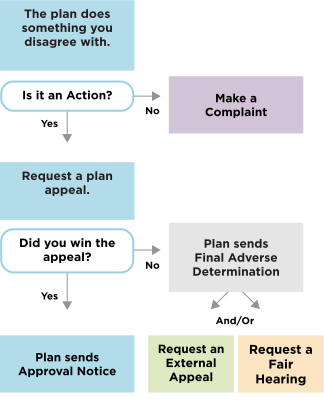
Appeals Process Diagram
Timing is important at each of these steps. Please read the brochure for details.
ICAN Can Help You
We can:
- Answer your questions about the appeals process in your Medicaid managed care plan.
- Identify and solve problems with your plan.
- Help you understand your rights.
- Help you file complaints and/or grievances if you are upset with a plan’s action.
- Help you appeal an action you disagree with.
ICAN can help.
Translations :
No translations